
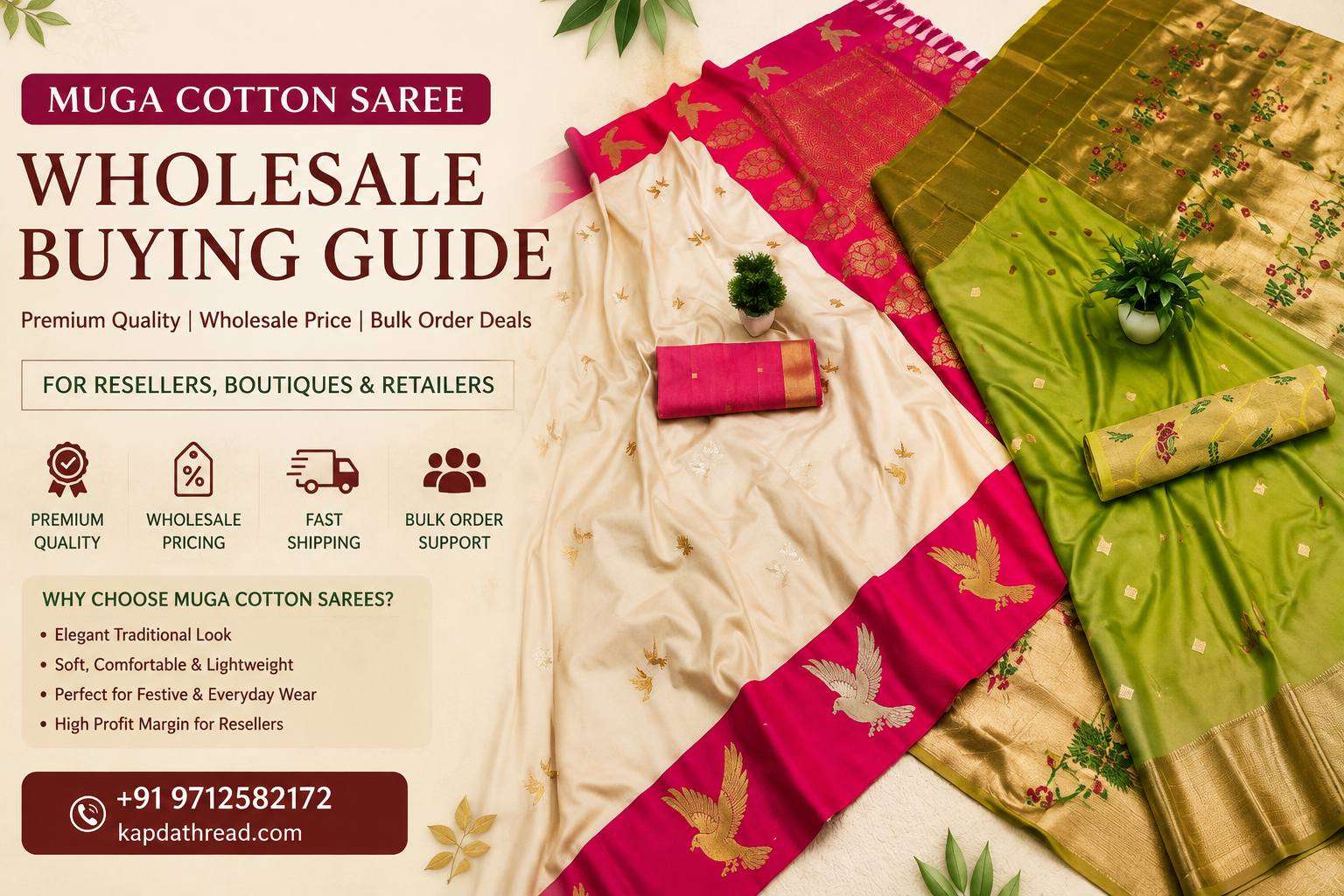
Muga Cotton Saree Wholesale Buying Guide
Muga Cotton Saree Wholesale Buying Guide 2026 – Price, Suppliers & Bulk Buying from Surat
For retailers, boutiques and resellers planning their next saree purchase, Muga cotton is becoming an attractive category because it combines a traditional appearance with practical selling potential. Buyers sourcing from Surat can access varied designs, competitive bulk rates and collections suitable for different regional and international markets. Understanding fabric quality, supplier reliability, order quantity, design selection and dispatch terms can help wholesale buyers build a more profitable saree inventory.
Introduction
The saree wholesale business continues to offer strong opportunities for sellers who select products according to customer demand instead of purchasing only on appearance. In 2026, buyers are increasingly looking for sarees that offer an elegant traditional feel, comfortable fabric and a price range suitable for repeat retail sales. This makes Muga cotton an interesting buying category for shop owners, boutique owners, showroom owners, home-based sellers and professional resellers.
A well-planned Muga Cotton Saree Wholesale purchase should consider more than the per-piece rate. Fabric feel, weaving appearance, border work, colour combinations, blouse details, catalogue presentation, packing and supplier consistency can all influence the final profitability of a collection. For wholesale buyers purchasing from the surat textile market, these factors become particularly important when ordering multiple designs or preparing stock for seasonal sales.
Surat has developed an extensive textile supply ecosystem covering sarees, dress materials, kurtis and other women’s ethnic wear. Important textile trading areas around ring road and sahara darwaza connect buyers with wholesalers, traders, distributors and manufacturing-linked suppliers. Online platforms have further simplified this sourcing process by allowing buyers outside Surat to check products and place bulk orders without making a physical market visit for every purchase.
Through kapdathread.com, buyers can explore wholesale ethnic wear collections while evaluating products according to their customer base, budget and business model. This can be especially useful for buyers who want to source from Surat while operating a retail shop, boutique, showroom, online store or home-based reselling business elsewhere.
Why Buy Muga Cotton Sarees in Wholesale?
Muga cotton sarees can create a valuable middle segment between everyday cotton sarees and heavier occasion-focused sarees. Their visual appeal can help retailers serve customers who want a graceful saree without necessarily choosing an extremely heavy or expensive design. For sellers, this provides opportunities to stock products for festive purchases, gifting, family functions, traditional occasions and regular ethnic wear requirements.
Purchasing Muga cotton sarees wholesale also gives retailers better flexibility in determining their selling margins. Instead of purchasing individual pieces at near-retail rates, bulk sourcing can provide a more workable purchase price, especially when catalogue quantities or larger assortments are selected.
Better Buying Margins for Resellers
Margin remains one of the biggest considerations for a reseller. A collection that looks attractive but leaves very little room between wholesale cost and expected retail price can be difficult to scale. Wholesale purchasing allows sellers to calculate product cost, shipping expense, applicable taxes and their desired profit before setting the final customer rate.
Home-based sellers can use this model to build a curated saree range without operating a large showroom. Boutique owners can select distinctive colour combinations for their regular customers, while shop and showroom owners can purchase broader assortments to serve walk-in demand. Professional wholesale buyers can select larger quantities for distribution to their own retail network.
Traditional Appeal with Wider Customer Potential
Customers often purchase sarees according to occasion, comfort, colour and perceived value. Muga cotton-inspired collections can work well where buyers prefer an ethnic appearance with manageable drape and attractive design detailing. This versatility gives retailers more opportunities to position the same product category for different customer groups.
When selecting Muga cotton saree suppliers, wholesale buyers should therefore compare not only designs but also the likely retail audience. A subtle woven pattern may appeal to customers looking for sophisticated traditional wear, whereas brighter combinations and decorative borders may perform better during festive buying periods.
Muga Cotton Saree Wholesale Price in 2026
The Muga cotton saree wholesale price is not fixed across every catalogue. Rates can change according to fabric composition, weaving style, border detailing, pallu design, blouse piece, finishing, catalogue size, quantity and supplier. Buyers should therefore avoid selecting stock only because one seller quotes the lowest rate.
For a business buyer, the more important question is whether the product quality supports the intended retail price. A slightly better-finished saree purchased at a reasonable wholesale rate may generate stronger customer satisfaction and repeat sales than an extremely low-cost product with inconsistent finishing.
Factors That Affect Wholesale Price
Fabric construction is one of the primary pricing factors. Design complexity, woven effects, decorative elements and finishing can further change the rate. Catalogue quantity also matters because some suppliers offer complete sets, while others may permit selected pieces depending on stock availability and their selling policy.
Bulk quantities can sometimes provide better purchasing terms, but buyers should confirm these terms before payment. The actual landed price should include product value, GST where applicable, transportation and any other dispatch expense. For international orders, buyers should also calculate export shipping and destination-related costs before determining their final selling rate.
Do Not Compare Sarees Only by Rate
Two products advertised under a similar saree category can differ considerably in fabric, weaving, finish and presentation. Comparing only the quoted rate can therefore produce an inaccurate buying decision. Request clear product information and review catalogue images carefully before confirming a large order.
Retailers should also calculate the realistic margin available in their own market. A product should match what customers in the targeted selling region are willing to pay. This is particularly important when building an online saree business where customers can quickly compare multiple designs and sellers.
How to Select Muga Cotton Sarees for Bulk Orders
A successful bulk purchase starts with the customer rather than the catalogue. Before ordering, identify who is most likely to buy the collection. The buying strategy for a premium boutique will naturally differ from that of a high-volume reseller or a neighbourhood saree shop.
When placing a Muga Cotton Saree Wholesale order, divide your selection across colours and design styles rather than purchasing too heavily into one visual theme. This can help provide customers with more choices and reduce dependence on a single design.
Check Fabric and Finish
Wholesale buyers should pay attention to the overall fabric appearance, drape, border finishing, pallu and blouse combination. Clear photographs and videos can help online buyers assess these features before ordering. For larger purchases, obtaining precise product details from the supplier is advisable.
Consistency also matters when buying a catalogue. If customers order after seeing promotional images, the supplied product should reasonably correspond with the catalogue presentation. Reliable product representation helps resellers maintain customer confidence.
Select a Balanced Colour Range
A good wholesale assortment can include traditional shades, lighter elegant tones and brighter festive options. Instead of assuming one colour will sell everywhere, buyers should select according to their local demand and previous sales experience.
Shop owners with established customer data can examine which shades sold faster in earlier saree collections. New resellers can begin with a manageable assortment and gradually reorder based on actual enquiries and conversions.
Understand MOQ Before Confirming the Order
Minimum order quantity can vary by catalogue and supplier. Some saree wholesalers in Surat may sell complete catalogue sets, whereas selected products can sometimes be available as singles or smaller assortments. Buyers should confirm MOQ, stock availability and dispatch policy before making payment.
This is particularly useful for home-based sellers and new boutique owners who want to test customer response before committing substantial capital to inventory.
Buying from Surat Textile Market
The surat textile market is one of the most important sourcing destinations for women’s ethnic wear buyers. Its extensive trading network gives retailers access to numerous product categories and price segments. Buyers searching for sarees can compare traditional ranges, contemporary catalogues and collections designed for regional or export markets.
Areas surrounding ring road are widely associated with textile trading activity. The broader sahara darwaza market belt is also familiar to buyers visiting Surat for wholesale textile purchases. Together, these areas form part of a large ecosystem involving traders, wholesalers, agents, logistics providers and manufacturing-related businesses.
Advantages of Surat-Based Wholesale Sourcing
One important advantage is variety. Wholesale buyers are not limited to a single saree segment and can often source complementary ethnic wear categories through the same city. This is useful for retailers who want to build mixed inventory rather than operating with only one product category.
Another advantage is access to an established supply chain. The relationship between manufacturing, wholesale trading, catalogue selling and transportation helps products move from suppliers to buyers across India and overseas markets.
Digital sourcing has made this ecosystem more accessible. Buyers using kapdathread.com can browse wholesale collections remotely, making Surat sourcing more practical for businesses that cannot frequently travel to the market.
Wholesale Buying Strategy for Different Types of Sellers
Every textile seller operates differently. Inventory capacity, customer profile, sales channel and available working capital should determine how much stock to purchase and which products to prioritize.
Home-Based Sellers and Resellers
Home-based sellers generally benefit from controlled inventory and faster stock rotation. Instead of buying excessive quantities immediately, they can choose attractive wholesale catalogues, promote them through WhatsApp, Instagram or their existing customer network, and increase purchases as demand develops.
A Muga cotton saree online wholesale sourcing model can be especially convenient because sellers can review new products without travelling to Surat. They can compare designs, calculate expected margin and purchase according to confirmed or anticipated demand.
Boutique Owners
Boutique customers often expect a more curated selection. Boutique owners can focus on sarees with distinctive colour combinations, refined borders and attractive traditional styling. Instead of keeping a very large number of similar pieces, they can select products that complement the boutique's positioning.
When purchasing Muga cotton sarees wholesale, boutique buyers should consider how the sarees will look in-store as well as in social-media photographs and customer videos. Strong visual presentation can increase enquiries and improve product discovery.
Shop and Showroom Owners
Physical retailers typically need wider inventory because customers expect immediate choice. A showroom can divide its saree stock across different price brackets and design preferences, allowing sales staff to show alternatives according to each customer's budget.
Repeat purchasing is equally important. A supplier who consistently introduces fresh designs can be more useful than a source offering only a one-time low rate. Retail businesses should therefore evaluate the long-term availability of wholesale saree collections when choosing sourcing partners.
Wholesale Supply for India, Nepal and Australia
Wholesale saree demand is not limited to one location. Ethnic fashion sellers serving customers in India, Nepal and Australia can evaluate Muga cotton collections according to local preferences, festive calendars and customer budgets. A supplier capable of handling domestic and international orders can make repeat procurement easier for businesses operating outside Surat.
For Indian buyers, transportation cost and delivery time should be considered along with the product rate. Buyers in Nepal should confirm the available shipping route, order terms and expected delivery process. Australian boutique and ethnic wear businesses should calculate international freight carefully because shipping can materially affect the final landed cost of each saree.
Before placing an export saree wholesale order, buyers should request clear information about packing, dispatch and documentation applicable to their shipment. International buyers can also reduce uncertainty by planning consolidated orders instead of evaluating the product price without considering freight.
Choosing a Reliable Wholesale Saree Supplier
A dependable supplier can become a long-term business asset. Wholesale purchasing involves repeated transactions, so reliability should be evaluated through product quality, communication, stock information, dispatch handling and transparency of buying terms.
Vastralife brings wholesale and export experience since 2017 along with practical textile industry expertise. This experience supports an understanding of what retailers, resellers and boutique buyers require when sourcing products remotely. Maintaining premium product quality and providing practical wholesale options can help business buyers build a more consistent purchasing process.
Check Product Information Before Payment
Before confirming a bulk order, verify the catalogue name, number of pieces, rate, stock status, applicable taxes, shipping charges and estimated dispatch process. Clear communication at the purchasing stage can prevent avoidable misunderstandings later.
Buyers should also check whether the supplier regularly deals in wholesale quantities. A business-focused supplier is generally better positioned to understand catalogue orders, repeat purchases, bulk packing and reseller requirements.
Look for Regular New Collections
Fashion inventory requires freshness. Customers who purchase sarees regularly want to see new colours, patterns and combinations. A wholesale source with frequent collection updates can help sellers keep their store, boutique or online catalogue active.
This is one reason buyers can use kapdathread.com to explore changing ethnic wear collections rather than depending entirely on occasional physical sourcing trips.
Plan Profit Before Placing a Bulk Saree Order
Wholesale buying becomes more effective when profit is calculated before stock is purchased. Start with the supplier's rate and add GST, transportation, packing and other applicable expenses. International buyers should include freight and import-related costs relevant to their destination.
After calculating the landed cost, compare it with the realistic selling price in your market. The difference must provide enough margin to cover marketing expenses, operating costs and expected profit. This simple calculation can prevent a business from purchasing attractive products that ultimately provide insufficient returns.
Buyers researching a saree manufacturer in Surat can compare sourcing possibilities according to quantity and collection requirements. Retailers expanding beyond sarees can also explore wholesale Pakistani suits online to create a broader ethnic wear inventory for their customers.
Keep Working Capital in Mind
Buying more stock does not automatically produce more profit. Unsold inventory locks working capital that could otherwise be used for new collections. Wholesale buyers should balance quantity discounts against expected stock rotation.
For new sellers, smaller and more varied purchases can provide useful information about customer preferences. Established stores with historical sales data can purchase larger quantities of proven categories with greater confidence.
How to Build a Profitable Muga Cotton Saree Inventory
A profitable saree inventory is built through careful selection rather than simply purchasing the largest possible quantity. Wholesale buyers should divide their budget among different colours, patterns and price segments so customers have enough variety without creating unnecessary dead stock. In 2026, faster inventory rotation can be more valuable than holding excessive quantities of a single catalogue.
When purchasing through the surat textile market, retailers can use previous sales records to understand which colours, border styles and price ranges perform best. Online resellers can study enquiries, saved products and customer responses before increasing stock. This approach helps turn wholesale purchasing into a data-driven business decision.
Start with Saleable Designs
A saree may look impressive in a catalogue but still need to match the expectations of your actual customer base. Home-Based Sellers and Resellers should initially prioritize versatile designs that can appeal to customers across multiple age groups and occasions. Boutique Owners can add distinctive designs to create a more exclusive selection.
Shop Owners and Showroom Owners generally have more display capacity, allowing them to stock a wider range. They can combine traditional shades with contemporary colours and offer multiple options at different selling prices. Wholesale Buyers supplying other retailers may prefer broader catalogue quantities because their inventory is distributed across several customers.
Reorder Based on Actual Customer Demand
One of the simplest ways to improve profitability is to track which products receive genuine customer interest. Record enquiries, confirmed orders, repeat colour requests and price objections. This information can guide the next wholesale purchase more accurately than assumptions about what might sell.
When a particular style performs well, check stock availability quickly. Fashion catalogues can move rapidly, especially during festival and wedding buying periods. Maintaining communication with a dependable supplier makes timely replenishment easier.
Seasonal Buying Strategy for Saree Retailers
Wholesale saree purchasing should ideally be planned around the sales calendar. Retailers preparing for festive periods, wedding seasons and regional celebrations should source sufficiently early to allow time for dispatch, product photography, marketing and customer sales.
A Muga Cotton Saree Wholesale purchase can be planned as part of a broader seasonal ethnic wear assortment. Instead of waiting until customer demand has already peaked, businesses can identify likely buying periods and prepare suitable inventory in advance.
Festive and Wedding Demand
Traditional-looking sarees can become particularly relevant during festive and family-event shopping. Retailers can select richer colours and eye-catching border combinations for such periods while retaining elegant options for customers who prefer understated designs.
Marketing should begin before the peak shopping period. Retailers can prepare WhatsApp catalogues, Instagram posts, customer broadcasts and in-store displays so that stock receives visibility as soon as it arrives.
Maintain Year-Round Options
Not every saree should be purchased only for festivals. Customers also buy sarees for gifting, social functions, religious occasions and personal wardrobe requirements throughout the year. Maintaining a balanced selection can help retailers generate sales outside major seasonal peaks.
Regularly checking new arrivals on kapdathread.com can help buyers identify fresh wholesale products and replenish their ethnic wear assortment according to current requirements.
Online Wholesale Buying Checklist Before Payment
Online sourcing can save substantial travel time, particularly for buyers located outside Surat, but every wholesale order should still be checked carefully. Before transferring payment, confirm the exact product, catalogue quantity, current stock availability, applicable price, GST terms and shipping charges.
Confirm the Exact Catalogue Details
Ask for the catalogue name, number of designs and available colours. If the supplier offers selected pieces rather than a complete set, confirm exactly which pieces will be dispatched. Product photographs or videos should be reviewed wherever available.
Confirm Dispatch and Shipping Terms
Ask when the order is expected to leave the supplier and which transport or courier option will be used. Buyers outside India should separately verify export shipping arrangements. The cheapest freight option is not always the best choice if delivery reliability is important for a retail launch.
Understand Replacement and Quality Policies
Wholesale transactions can follow different policies from normal retail purchases. Buyers should understand the supplier's procedure for manufacturing defects, wrong products or other eligible claims. Checking the policy before ordering is more practical than resolving uncertainty after delivery.
Why Surat Remains Important for Wholesale Saree Buyers
Surat continues to play a significant role in India's textile trade because of the scale of its supply ecosystem. Buyers around ring road and sahara darwaza can find businesses dealing across multiple textile categories, while the city's connections with production, processing, trading and transportation support large-volume distribution.
The combination of manufacturing capabilities and wholesale trading also gives business buyers access to changing designs and multiple pricing segments. This matters for retailers who need regular new products rather than relying on the same inventory throughout the year.
Online wholesale sourcing has extended the reach of this ecosystem. A retailer no longer has to make a physical trip for every catalogue purchase. Product information can be reviewed remotely, orders can be discussed with suppliers and goods can be dispatched to different regions according to available shipping services.
Muga Cotton Saree Wholesale for International Buyers
Indian ethnic wear has a customer base well beyond the domestic market. Retailers serving Indian and South Asian communities overseas can add sarees to their inventory according to local festivals, weddings and cultural events. Buyers in Nepal and Australia, along with businesses throughout India, can evaluate wholesale sourcing from Surat according to their market size and customer preferences.
International wholesale buyers should focus on landed cost rather than only the product rate. Freight can significantly change the actual per-piece cost, particularly for small shipments. Consolidating suitable quantities can sometimes make shipping economics more practical, depending on destination and logistics arrangements.
Prepare Export Orders Carefully
Before an international shipment is finalized, confirm the quantity, packing, invoice information, dispatch method and expected logistics charges. Buyers should also understand any destination-specific duties, taxes or import requirements applicable to their business.
For an export saree supplier from Surat, consistent communication is especially important because the buyer cannot physically inspect every shipment before dispatch. Clear catalogue information, proper packing and dependable coordination can contribute to a smoother long-term wholesale relationship.
Common Wholesale Buying Mistakes to Avoid
One common mistake is purchasing solely because a supplier offers a very low rate. A low buying price has limited value if the design is difficult to sell, the product quality disappoints customers or the retailer has to discount heavily to clear inventory.
Another mistake is purchasing too many similar designs. Even if one colour performs strongly, customer preferences can vary. A more balanced assortment provides additional selling opportunities and reduces dependence on one product.
Ignoring Total Landed Cost
Product rate is only one component of the investment. GST, freight, packaging and other applicable expenses should be included when calculating the real cost. This becomes even more important for overseas buyers because international shipping can materially change the final cost per piece.
Buying Without Knowing the Customer
Retailers should not select stock solely according to personal taste. A boutique serving premium customers will need a different assortment from a price-focused reseller. Likewise, customer preferences in one region may differ from another. Purchasing should be based on actual market demand whenever possible.
Ordering Too Much on the First Purchase
A new collection should ideally be tested before a retailer commits excessive working capital. Begin with a sensible assortment, evaluate response and reorder successful products when available. This helps maintain cash flow while keeping inventory fresher.
Why Experience Matters When Choosing a Wholesale Partner
Textile wholesale is not simply about uploading catalogue photographs and quoting a rate. Buyers need practical support with product selection, quantity, dispatch and repeat sourcing. Industry knowledge becomes particularly valuable when a retailer is purchasing remotely or developing a new product category.
Vastralife has wholesale and export experience since 2017, supported by broader textile industry expertise and experience serving business buyers. This background helps in understanding the requirements of retailers, boutiques, resellers and wholesale customers looking for dependable ethnic wear sourcing.
Attention to premium product quality is equally important. For a reseller, every dispatched product represents their own reputation in front of the final customer. Selecting reliable products therefore contributes not only to immediate sales but also to customer retention and repeat business.
Internal Linking Section
Wholesale buyers can use the related sourcing pages already referenced above to continue exploring relevant saree and ethnic wear categories. These resources are useful when comparing Surat-based sourcing options or expanding inventory beyond one saree segment.
When exploring kapdathread.com, buyers should compare collections according to customer demand, purchase budget, expected retail margin and required quantity. A mixed ethnic wear strategy can help boutiques, showrooms and resellers serve more customer requirements without depending entirely on a single product category.
Customer FAQs
1. Where can I buy Muga cotton sarees wholesale from Surat?
Wholesale buyers can source through established Surat textile suppliers and online wholesale platforms connected with the city's textile trade. Before ordering, check current stock, catalogue quantity, product details, wholesale rate and shipping terms.
2. What is the Muga cotton saree wholesale price in 2026?
The wholesale rate varies according to fabric, weaving, border design, blouse details, finishing, quantity and catalogue. Buyers should request the current quotation for the specific collection they want rather than relying on a general market rate.
3. Can Home-Based Sellers purchase Muga cotton sarees in wholesale?
Yes. Home-Based Sellers can purchase according to the MOQ available for a particular collection. Starting with controlled quantities and multiple saleable designs can be a practical way to test customer demand before increasing investment.
4. Are these sarees suitable for Boutique Owners and Showroom Owners?
Yes. Boutique Owners can select curated designs and colour combinations, while Showroom Owners can build a broader assortment across different customer preferences and selling prices.
5. Can wholesale sarees be supplied outside Surat?
Yes, wholesale textile orders can be dispatched to buyers in different parts of India subject to supplier and shipping availability. Confirm transportation charges and delivery details while finalizing the order.
6. Can international buyers place saree export orders?
International buyers can discuss bulk and export requirements according to destination, quantity and available logistics options. Shipping charges, documentation and destination-specific import requirements should be checked before payment.
7. What should Resellers check before ordering a saree catalogue?
Resellers should verify catalogue quantity, colours, fabric information, wholesale rate, GST, shipping, stock availability and applicable quality-claim policies. They should also calculate their expected retail margin before confirming the purchase.
8. Is it better to purchase a full catalogue or selected pieces?
The better option depends on the supplier's MOQ and your business model. A shop with regular saree sales may benefit from complete catalogue variety, while a smaller reseller may prefer selected pieces when that option is available.
9. How can Wholesale Buyers improve profit margins?
Calculate the complete landed cost first, select products that match proven customer demand and avoid excessive slow-moving inventory. Regular stock rotation and sensible retail pricing are generally more sustainable than buying solely because of a quantity discount.
10. Why source ethnic wear from Surat?
Surat provides access to a large textile ecosystem covering manufacturing, wholesale trading and distribution. Its broad selection makes the city useful for retailers who require regular new collections and multiple ethnic wear categories.
Order Wholesale Ethnic Wear for Your Business
If you are a Home-Based Seller, Shop Owner, Boutique Owner, Showroom Owner, Reseller or Wholesale Buyer looking to strengthen your ethnic wear inventory, choose products according to your customer demand and required profit margin. A reliable sourcing strategy can help you introduce fresh designs regularly while keeping purchasing costs under control.
Explore Latest Collections with competitive Wholesale Pricing for retailers and resellers. Discover Trendy Ethnic Wear, convenient Fast Shipping, available COD Support, attractive Bulk Order Deals and Quality Products Starting From ₹299.
Start Your Wholesale Purchase Today
Website: kapdathread.com
Contact: +91 9712582172
Whether you are building your first online reselling collection or regularly purchasing stock for an established boutique or showroom, thoughtful sourcing can make a meaningful difference to inventory rotation and profitability. Compare quality, calculate the complete cost, understand your customers and choose wholesale collections that offer both visual appeal and practical selling potential.