
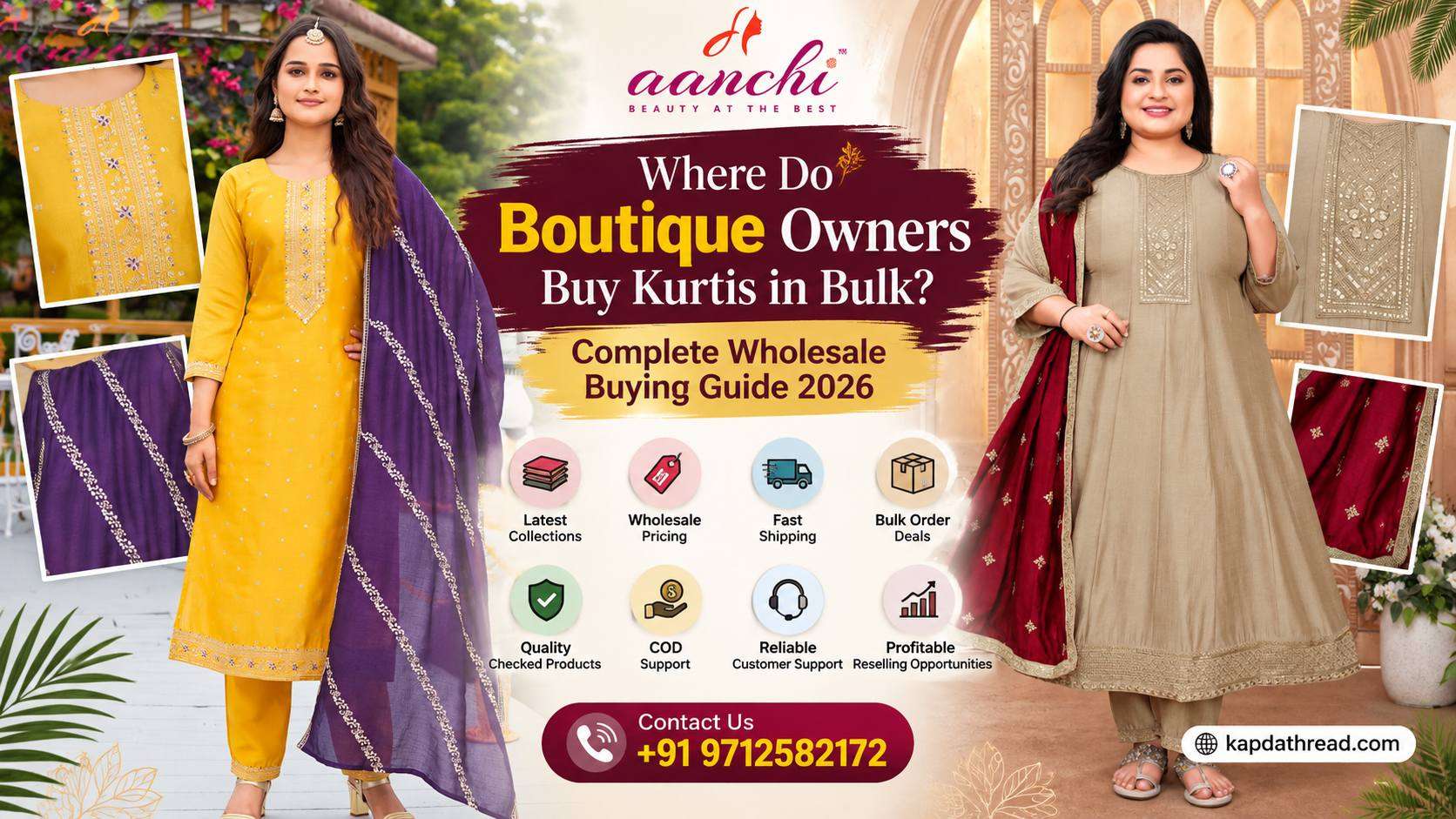
where do boutique owners buy kurtis in bulk
Where Do Boutique Owners Buy Kurtis in Bulk? Wholesale Buying Guide 2026
For a boutique owner, choosing the right kurti supplier is directly connected to sales, repeat customers and profit margins. Attractive designs alone are not enough; retailers need dependable stock availability, practical minimum order quantities, competitive wholesale rates and collections that can be reordered when customers respond well. That is why many boutique owners source directly from established textile markets, manufacturers and online wholesale platforms rather than depending entirely on local distributors.
Introduction
If you are searching for where do boutique owners buy kurtis in bulk, Surat is one of the major sourcing destinations worth considering. The city has a large textile ecosystem covering fabrics, manufacturing, designing, stitching, finishing, packaging, wholesale trading and dispatch. This gives boutique owners access to numerous styles and price segments without depending on only one type of supplier.
In 2026, wholesale purchasing has also become much more digital. Boutique owners no longer need to travel every time they want fresh inventory. They can browse collections online, compare designs, check the wholesale price, place a bulk order and arrange delivery directly to their city. Platforms such as kapdathread.com are designed to make this process easier for boutique owners, shop owners, resellers, home-based sellers, showroom owners and wholesale buyers.
The buying requirement of a boutique is different from that of a large chain store. A boutique may want several fresh designs in manageable quantities instead of putting its entire investment into one catalogue. Successful sourcing therefore involves finding a supplier that can provide variety, consistent quality and suitable quantities while keeping the buying cost commercially practical.
Why Boutique Owners Buy Kurtis Directly from Wholesale Suppliers
Every additional layer between manufacturing and retail can influence the final buying cost. This is one reason boutique owners increasingly search for kurti wholesale suppliers, manufacturers and direct wholesale platforms. A competitive purchase price gives retailers more flexibility when deciding their final selling price, promotional discounts and expected margin.
Direct sourcing is particularly useful when purchasing designer kurtis wholesale, cotton kurtis, rayon kurtis, printed kurtis, embroidered styles, kurti-pant sets, festive collections, plus-size kurtis and everyday wear. Instead of relying on whatever stock is available through a nearby intermediary, buyers can select products based on their own customer profile.
For example, a home-based seller may concentrate on affordable everyday kurtis, while a premium boutique may require coordinated sets and detailed embroidery. A high-street showroom might need both categories. A good bulk kurti supplier allows buyers to create a product mix rather than forcing every retailer into the same inventory strategy.
Better Wholesale Price for Resale
Margin begins at the buying stage. When a retailer purchases stock at an unnecessarily high rate, there is limited room to compete on the final retail price. Sourcing from a wholesale textile hub can help buyers compare different ranges before committing capital.
For retailers searching phrases such as buy kurtis in bulk, kurti wholesale price, wholesale kurti online, kurtis for reselling and boutique kurti suppliers, the objective is usually transactional: they want products that can actually be ordered and resold profitably.
More Designs Without Depending on One Local Market
Customers expect boutiques to refresh their racks frequently. A shopper who sees exactly the same merchandise every few weeks has less reason to return. Wholesale sourcing gives boutique owners access to new prints, silhouettes, fabrics and colour combinations throughout the season.
Trending categories can include straight kurtis, A-line kurtis, Anarkali styles, printed rayon kurtis, cotton kurtis, embroidered kurtis, kurti sets, office-wear kurtis, festive ethnic wear and larger-size collections. Buying across categories can help a retailer serve more customer requirements from the same store.
Surat: A Major Destination for Bulk Kurti Buying
When Indian retailers ask where do boutique owners buy kurtis in bulk, Surat frequently appears in the sourcing conversation because of its established textile trade. Areas connected with the surat textile market, ring road and sahara darwaza bring together textile traders, manufacturers, wholesalers and related businesses.
The advantage is not simply the number of shops. Surat's broader textile ecosystem supports sourcing across multiple product categories and price bands. Buyers may find daily-wear products for price-sensitive customers as well as designer pieces intended for boutique presentation.
Retailers looking for Surat kurti wholesale market, ladies kurti wholesalers, kurti manufacturers in Surat, wholesale ethnic wear and kurtis for resale can therefore evaluate a broader range of merchandise.
Manufacturing and Wholesale Supply in One Textile Ecosystem
Surat's connection with textile manufacturing is useful for buyers who want to build a long-term sourcing system rather than purchase a few pieces once. Repeat wholesale buyers usually need regular new arrivals, predictable dispatch and suppliers capable of handling growing order volumes.
Vastralife brings wholesale and export experience since 2017 to this ecosystem. That industry experience is relevant for buyers who require premium product quality, practical wholesale support and collections selected for resale rather than personal shopping.
For boutique owners, the goal should not be to select a supplier purely because one catalogue has the lowest price. Fabric feel, stitching, finishing, colour presentation, sizing, design appeal and consistency matter because the boutique eventually has to answer directly to its customers.

What Types of Kurtis Should Boutique Owners Buy in Bulk?
A strong boutique inventory normally combines proven sellers with trend-driven products. Ordering only fashionable statement pieces can make sales inconsistent, while stocking only basic designs can make a boutique look repetitive. The better approach is to build several commercially useful categories.
Cotton and Everyday Wear Kurtis
Cotton kurtis wholesale remain an important buying category for stores serving customers who prioritise comfort and repeat everyday use. Straight cuts, simple prints and wearable colour combinations can be stocked for office wear, casual use and regular outings.
These products are particularly suitable for home-based sellers and retailers who need merchandise with a broad customer base. Buyers searching to buy wholesale kurtis online should consider keeping enough everyday designs alongside higher-value products.
Rayon Printed Kurtis for Fast-Moving Inventory
Rayon styles can provide attractive drape and strong visual presentation at accessible price points. Floral patterns, traditional motifs, geometric designs and contemporary prints allow boutiques to create frequent new-arrival campaigns without changing their entire product category.
For a reseller, these designs can also work well in WhatsApp catalogues, Instagram product posts and online selling because prints are immediately visible in photographs.
Kurti Sets and Coordinated Ethnic Wear
Many customers prefer ready combinations instead of separately matching a kurti with bottoms. This makes kurti-pant sets and three-piece ethnic combinations commercially useful for boutiques. Retailers can position them for office wear, gifting, festive shopping, family functions and semi-formal occasions.
Buyers comparing kurti sets wholesale should look beyond the top alone. Bottom fabric, dupatta quality where included, finishing and overall coordination affect how premium the complete product appears on a boutique rack.
Plus-Size Kurtis for a Wider Customer Base
Size availability can directly influence the number of customers a boutique can serve. Maintaining a dedicated plus-size range helps retailers avoid losing buyers who like a design but cannot find it in their preferred size.
Instead of treating extended sizing as occasional inventory, boutiques can maintain a consistent plus size kurtis wholesale selection with everyday, office, festive and designer options. This can be especially valuable for retailers trying to build repeat customers around fit availability.
How Boutique Owners Can Select the Right Wholesale Kurti Supplier
Finding a supplier is easy; finding one that works consistently for your business requires more attention. Boutique owners should evaluate the complete buying process rather than judging a supplier through a few catalogue photographs.
Check Product Quality Before Scaling Orders
Quality is one of the strongest factors behind repeat retail business. Customers remember poor stitching, inconsistent sizes and weak fabric even if the product initially looked attractive. Wholesale buyers should therefore evaluate material, finishing, stitching and overall presentation before increasing purchase volume.
Premium product quality becomes even more important for boutiques because customers often expect better selection than they would from a generic mass-market store.
Compare MOQ with Your Sales Capacity
A low buying rate does not automatically make an order profitable. If a supplier requires far more pieces than a boutique can sell comfortably, capital may remain blocked in slow-moving inventory.
Buyers should therefore compare the minimum order quantity with their customer base, monthly turnover and available inventory budget. A manageable MOQ can allow smaller sellers to test new products before placing larger repeat orders.
Look for Regular New Arrivals
For a boutique, freshness is part of the business model. Regular new arrivals provide content for social media, WhatsApp status updates and customer broadcasts while also giving repeat shoppers something different to see.
A supplier capable of offering latest kurti designs wholesale across different seasons can become more useful than repeatedly searching for a new source for every collection.
Evaluate Dispatch and Shipping Support
Fast-moving boutique inventory needs timely replenishment. A product that sells well today may lose momentum if restocking takes too long. Before placing a bulk order, buyers should understand dispatch procedures, shipping options and available order support.
This becomes even more important for wholesale buyers outside Surat and for export customers who need sufficient time for transport and local distribution.
Buying Kurtis in Bulk Online in 2026
Online wholesale sourcing has changed how smaller retailers compete. Previously, a boutique owner might have needed a physical buying trip to access Surat collections. In 2026, digital wholesale platforms make it possible to review merchandise remotely and place orders from different locations.
Through kapdathread.com, buyers can explore wholesale-focused ethnic wear without restricting their sourcing to a nearby local distributor. This approach is useful for boutique owners, resellers and shop owners who want to purchase fresh merchandise more frequently.
For businesses comparing plus size kurtis wholesale, online sourcing provides an efficient way to expand size-oriented inventory. Retailers that also sell broader ethnic collections can explore wholesale Pakistani suits online as a complementary category for customers seeking more elaborate styles.
For online buyers, the transactional advantage is convenience: collections can be shortlisted, quantities planned and orders placed without making every sourcing decision dependent on travel. That can be especially valuable for smaller businesses where the owner personally manages sales, customer communication and purchasing.

How Much Stock Should a Boutique Owner Buy?
The right quantity depends on the size of the business, existing customer demand and how quickly the retailer can rotate inventory. Boutique owners should not think only about getting the lowest possible wholesale price. The more important question is how quickly each purchased piece can convert back into cash.
For a new boutique or home-based seller, a mixed order containing different designs, colours and sizes can often be more practical than investing heavily in a single catalogue. Once actual customer demand becomes clear, successful designs can be reordered or similar collections can be added.
Established shop owners and showroom owners may use a different strategy. They can maintain deeper stock in proven categories while continuously testing new arrivals. This combination helps keep the store fresh without sacrificing dependable sellers.
Start with Variety and Scale What Sells
If you are placing your first wholesale order, prioritise variety. Instead of assuming what customers will buy, let actual sales data guide the next purchase. Track which sizes, fabrics, colours, price points and silhouettes move fastest.
For example, if printed rayon kurtis consistently sell faster than heavily embellished pieces, the next bulk purchase can increase the rayon allocation. If customers frequently request coordinated outfits, increase the percentage of kurti-pant sets. This creates a purchasing cycle based on real demand rather than guesswork.
Keep Reordering Capital Available
One common mistake is spending the complete purchasing budget in a single order. A boutique should ideally retain enough working capital to reorder fast-selling designs and buy newly launched collections. Fashion changes quickly, and customers frequently respond to products they see through social media and digital catalogues.
For this reason, retailers searching for kurtis in bulk for resale should consider stock rotation as carefully as the initial buying price. Faster rotation can be more valuable than purchasing excessive quantities merely to obtain a small per-piece discount.
Wholesale Kurti Buying for India and Export Markets
The Indian ethnic wear market is not limited to domestic retail. Kurtis, kurti sets and related women's ethnic wear also have buyers in international markets with Indian and South Asian communities. Wholesale sourcing can therefore support both local boutiques and businesses supplying customers abroad.
Among the markets relevant to this category are India, Nepal and Australia. However, product selection should reflect the target market rather than sending exactly the same assortment everywhere.
Wholesale Kurtis for Indian Retailers
Indian boutique owners can source across everyday, office, festive and occasion-wear categories because the domestic customer base is broad. A store can combine cotton and rayon daily wear with designer kurtis, plus-size options, coordinated sets and seasonal ethnic collections.
Retailers purchasing from the surat textile market ecosystem can also refresh stock around festivals, wedding seasons and regional demand cycles. Buyers around ring road and sahara darwaza encounter a large textile trading network connected with wholesale supply and manufacturing.
Wholesale Kurtis for Nepal
Nepal offers demand for Indian ethnic fashion across regular wear, festive shopping and occasion-based collections. Wholesale buyers serving Nepal should plan orders with transportation lead time in mind rather than waiting until the retail selling period has already started.
For seasonal stock, advance purchasing gives the retailer time to receive products, organise displays, photograph merchandise and promote the collection before customer demand reaches its peak. Buyers should confirm current shipping arrangements and charges before finalising an order.
Wholesale Kurtis for Australia
Retailers and resellers serving Indian communities in Australia can build assortments around festivals, cultural functions, family celebrations and everyday ethnic fashion. Lightweight pieces, coordinated sets and designer products can address different customer segments.
International wholesale buyers should confirm product availability, order quantity, shipping and applicable import requirements before purchase. A reliable export sourcing relationship becomes increasingly valuable when a retailer needs repeat stock rather than a one-time shipment.
What Boutique Owners Should Check Before Placing a Bulk Order
Before confirming a wholesale purchase, review the order commercially. A beautiful catalogue is only one part of the decision. The product must also fit your target customer's spending range, size requirements and style preferences.
Check the available sizes, fabric description, number of pieces, design assortment, wholesale price and dispatch details. For larger purchases, confirm exactly what is included in the catalogue or set. This reduces confusion after the stock reaches your store.
Check the Selling Potential, Not Just the Buying Price
A ₹100 difference in purchase cost means little if the cheaper product remains unsold. Boutique owners should evaluate perceived value: does the product look attractive enough for the retail price you intend to charge? Will customers understand why it belongs in your boutique?
A product with good fabric, appealing colour combinations and cleaner finishing can sometimes provide better commercial value even when its purchase cost is slightly higher. This is particularly important for boutique customers who examine garments closely before buying.
Build Stock Around Multiple Price Points
Not every customer entering a boutique has the same budget. Maintaining entry-level, mid-range and premium merchandise helps the retailer serve more shoppers without diluting the store's positioning.
Affordable wholesale kurtis can attract regular buyers, while premium designer sets can increase average order value. This makes a balanced inventory more commercially useful than concentrating the entire purchase budget in one price segment.
Why Regular New Collections Matter for Boutique Sales
Fashion retail benefits from freshness. Customers who follow a boutique through WhatsApp, Instagram or other digital channels expect to see new merchandise regularly. Every fresh wholesale purchase can become a new marketing opportunity.
A retailer can announce “New Arrivals,” “Fresh Surat Collection,” “Limited Stock,” “New Plus-Size Collection” or “Festive Collection” instead of repeatedly promoting old inventory. This is one reason buyers searching where do boutique owners buy kurtis in bulk should consider the supplier's frequency of new launches, not simply the number of products currently available.
kapdathread.com can be used by wholesale buyers looking to discover different ethnic wear categories and purchase stock according to their business requirements. Regular sourcing also allows boutiques to respond to trends without committing too much money to a single fashion direction.
How Home-Based Sellers Can Start Buying Wholesale Kurtis
A physical showroom is not essential for beginning an ethnic wear resale business. Home-based sellers can start with manageable wholesale inventory, promote products digitally and increase quantities as their customer base grows.
The first objective should be learning what the audience actually purchases. Start with a sensible assortment of everyday kurtis, fashionable designs and a few coordinated sets. Photograph the merchandise clearly, mention sizes and prices transparently and maintain quick communication with interested customers.
Use WhatsApp and Social Media to Rotate Stock
Fresh inventory can be promoted through WhatsApp Status, customer groups, Instagram Reels, Facebook posts and direct catalogue sharing. Instead of uploading every product simultaneously, sellers can introduce collections gradually to maintain customer attention.
As orders increase, buying from a dependable wholesale kurti supplier becomes increasingly important because regular availability and new designs allow the reseller to maintain momentum.
Move from Small Orders to Repeat Bulk Purchasing
Once a seller understands which products move fastest, purchasing becomes more systematic. Repeat buying can focus on successful price ranges, sizes and fabrics while still allocating part of the budget to new designs.
This gradual approach can reduce unnecessary inventory risk and is useful for anyone searching for bulk kurtis for business, online reselling stock, boutique wholesale clothing or ethnic wear wholesale suppliers.
Internal Linking Section
Boutique owners should build their buying plan around complementary categories rather than treating every product independently. A customer purchasing an everyday kurti today may later require a plus-size style, festive suit or premium ethnic set. Keeping related categories within the same sourcing strategy can help retailers increase repeat business.
When planning the next purchase, compare sizes, fabrics, designs, price points and seasonal requirements before allocating the budget. The objective is to create a collection that gives customers enough choice while keeping inventory commercially manageable.
Vastralife's wholesale and export experience since 2017 adds practical industry understanding to sourcing, product selection and wholesale supply. For retailers, working with experienced industry participants can be particularly useful as order volumes increase and consistent premium product quality becomes more important.
Customer FAQs
1. Where do boutique owners buy kurtis in bulk?
Boutique owners commonly source through wholesale textile markets, manufacturers, established wholesalers and online B2B platforms. Surat is a major Indian textile sourcing centre, while platforms such as kapdathread.com allow buyers to browse wholesale-focused collections online and place orders without depending entirely on local distributors.
2. Can I buy wholesale kurtis for a home-based resale business?
Yes. Home-based sellers can purchase wholesale stock and sell through WhatsApp, Instagram, Facebook or their existing customer network. Starting with a varied assortment and then increasing quantities according to actual sales can make inventory easier to manage.
3. What type of kurtis should a boutique buy in bulk?
The exact mix depends on the boutique's customers, but common wholesale categories include cotton kurtis, rayon printed kurtis, straight kurtis, A-line styles, designer kurtis, embroidered pieces, kurti-pant sets, festive wear and plus-size kurtis. A mix of everyday and higher-value products can serve different purchasing occasions.
4. How should I compare wholesale kurti prices?
Do not compare the price alone. Check fabric, stitching, finishing, sizing, design, quantity requirements, shipping and expected retail value. The best commercial purchase is usually the product that combines a workable buying cost with strong resale potential.
5. Can wholesale kurtis be supplied outside India?
Wholesale and export orders can serve international buyers, subject to destination, shipping arrangements and applicable import requirements. Buyers should confirm current order and delivery terms before payment, particularly for international shipments.
6. Is Surat a good place to source kurtis for boutiques?
Surat has a substantial textile manufacturing and wholesale ecosystem. Buyers source women's ethnic wear through markets and suppliers connected with areas such as Ring Road and Sahara Darwaza. Online sourcing can also help retailers access Surat-based merchandise without travelling for every order.
7. How often should boutique owners purchase new stock?
There is no single schedule for every business. Retailers should watch stock rotation and reorder fast-moving products while introducing new designs frequently enough to keep their collection fresh. Seasonal and festive merchandise should be planned earlier so that stock arrives before peak customer demand.
Order Wholesale Kurtis for Your Boutique
If you are ready to refresh your boutique, showroom, online store or home-based resale business, explore wholesale ethnic wear according to your customer demand and purchasing budget.
At kapdathread.com, wholesale buyers can explore Latest Collections, competitive Wholesale Pricing, Trendy Ethnic Wear and regularly updated products suitable for resale.
Wholesale buying support includes Fast Shipping, available COD Support subject to applicable order terms, Bulk Order Deals and Quality Products Starting From ₹299. Product availability, exact price, MOQ and shipping terms should be confirmed for the selected collection when ordering.
Whether you are a boutique owner, shop owner, showroom owner, reseller, home-based seller or wholesale buyer, build your inventory around products your customers can actually wear, value and return to purchase again.
Contact Number: +91 9712582172
Website: kapdathread.com
Choose your latest collection, plan the right quantity and place your wholesale order to keep your store ready with fresh ethnic wear for the 2026 market.